
Artificial intelligence (AI) is transforming various industries, including education and finance. While AI has begun to revolutionize the way we approach learning, its integration into real-world industries is becoming increasingly evident. As I prepare to enter the finance industry after graduation, I have observed that AI is already playing a significant role in shaping the field. IBM (International Business Machines) published an article highlighting AI’s presence in financial services, particularly in risk management, portfolio management, predictive analytics, loan processing, and more (Downie and Finio). Given the relatively recent adoption of AI in finance, it still requires substantial oversight from human employees, which is to be expected.
Among the various applications of AI, one of the most impactful has been its ability to detect unusual trading patterns. Financial institutions utilize AI to identify potential fraud or errors in trading activity, thereby enhancing security and efficiency. The primary objective of AI in finance is to improve operational efficiency, allowing companies to identify and address issues more effectively while ultimately saving costs.
Forbes shares a similar perspective with IBM, emphasizing that AI’s most significant contribution to finance is its ability to detect fraudulent activity (Walch). By automating fraud detection, AI can identify anomalies more efficiently than human employees. While some argue that AI’s increasing role in finance may lead to job displacement, others believe it enables employees to focus on more complex and strategic tasks.
To assess AI’s impact on employment in the financial sector, I examined data from the Bureau of Labor Statistics over the past four months. Despite AI’s growing presence, employment in the financial industry has continued to rise at a steady rate. Historical trends over the past few years also indicate a consistent increase in job opportunities, as reflected in the data.
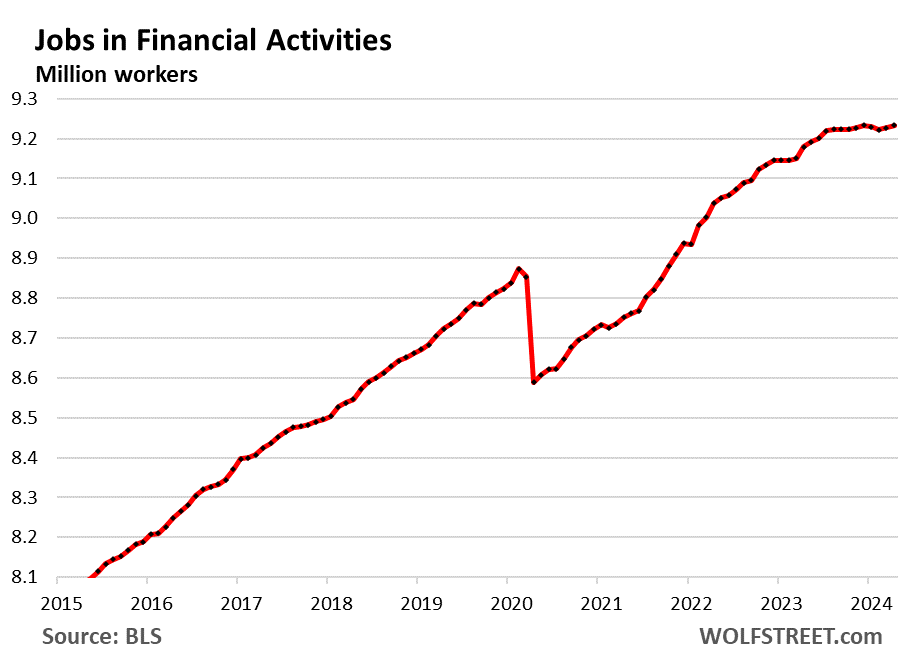
Although the long-term impact of AI on employment in finance remains uncertain, current trends suggest that AI may not lead to widespread job losses as some fear. Instead, AI appears to complement human efforts, allowing employees to focus on higher-value tasks while AI handles fraud detection and other routine functions. As AI technology continues to evolve, ongoing research will be essential to fully understand its implications for the workforce and the broader financial industry.
Works Cited
Downie, Amanda, and Matthew Finio. “Artificial Intelligence in Finance.” IBM, https://www.ibm.com/think/topics/artificial-intelligence-finance. Accessed 1 Apr. 2025.
Walch, Kathleen. “How AI Is Transforming the Finance Industry.” Forbes, 14 Sept. 2024, https://www.forbes.com/sites/kathleenwalch/2024/09/14/how-ai-is-transforming-the-finance-industry/. Accessed 1 Apr. 2025.
Rewritten and Revised by ChatGPT4-0